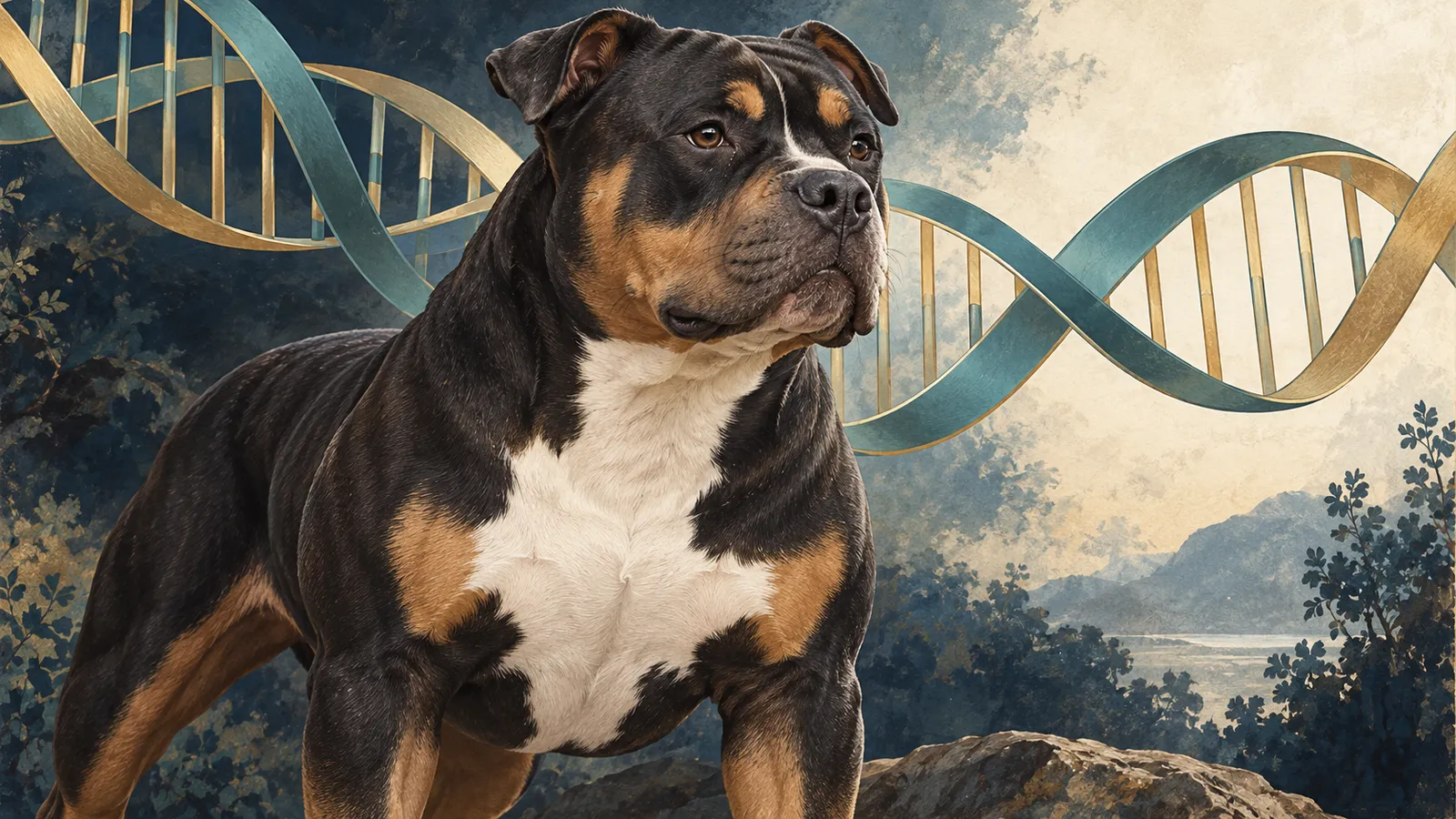
Tri-Colour Genetics Without the Guesswork
Why a colour label cannot tell you everything a dog may pass on.
“Tri-colour” describes an appearance, not one complete genetic recipe. In American Bully conversation, it usually refers to a coat combining a base colour, tan markings, and white. Predicting that appearance in puppies requires looking at several interacting parts of coat-colour genetics.
Dogs produce two main pigments: eumelanin, responsible for black and related colours, and phaeomelanin, responsible for red and yellow shades. Genes influence where those pigments appear and how they are modified. Brown and dilution variants can change the appearance of eumelanin, while white markings involve additional genetic factors. UC Davis: dog coat colour
Tan points are part of a larger system
Older genetic reports often use aᵗ for the tan-point pattern at the A locus. Modern testing can describe ASIP patterns in more detail, including combinations associated with a black-back or black-and-tan appearance.
UC Davis updated its Agouti testing terminology because the older categories did not fully explain the observed patterns. When comparing reports from different laboratories or years, check the laboratory’s explanation instead of assuming every label means precisely the same thing. UC Davis: Agouti testing
Other genes can change whether the underlying pattern is visible. Dominant black at the K locus can mask Agouti patterns, while recessive red at the E locus can prevent black pigment from appearing in the hair. UC Davis: coat-colour interactions
Can two tri-colour parents produce puppies without visible tan points?
They can under particular genetic circumstances, but “two tris can produce anything” is not a useful explanation.
Consider a simplified example in which both visibly tan-pointed parents carry one recessive-red allele: E/e × E/e. Each puppy has a 25% probability of inheriting e/e. That genotype produces a recessive-red or cream-type coat that can conceal the underlying Agouti pattern. White markings may still be present. The 25% is a probability for each puppy, not a promise that exactly one puppy in four will have that appearance. UC Davis: E-locus testing
Another possibility involves recessive black at ASIP, if both parents carry it. Its relevance must be established from testing rather than presumed from appearance. UC Davis: Agouti results
Record results, not just descriptions
A useful pedigree profile distinguishes the dog’s observed colour from its tested genotype. Include the laboratory, report date, and the exact results rather than only a breeder’s shorthand.
When predicting a litter, examine both parents’ relevant results together and ask the testing laboratory to explain uncertain combinations. Colour genetics becomes much easier to discuss when the conversation starts with evidence rather than photographs alone.