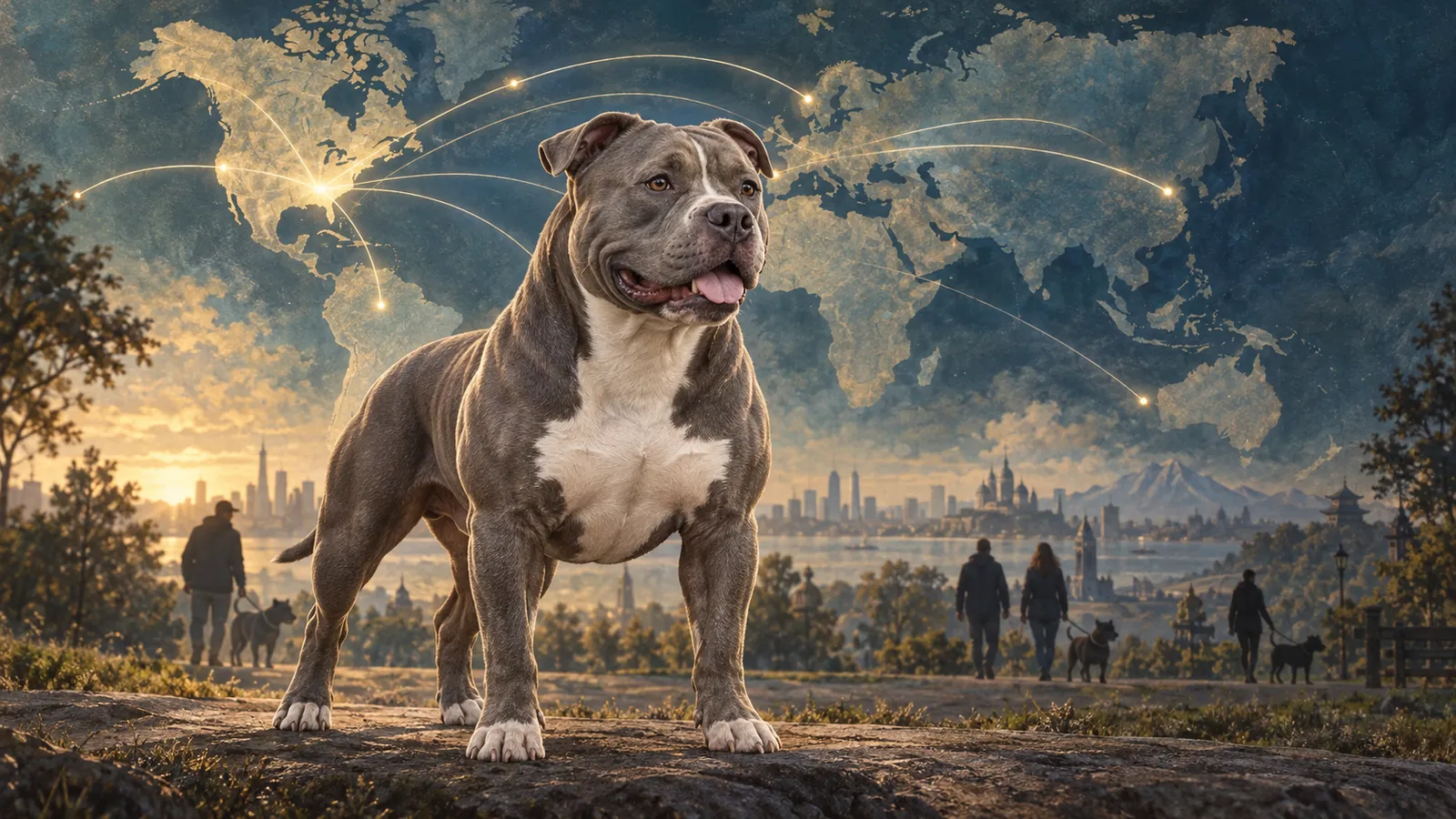
The American Bully: American Roots, a Worldwide Community
How a 1990s American breeding movement became a recognized breed with its own registries, international shows and a worldwide community.
The American Bully’s story is still being written. Within a few decades, a breeding movement in the United States developed into a distinct breed with dedicated registries, international shows, and a community that reaches far beyond its country of origin. Understanding that journey means looking at the dogs behind the pedigrees, and the people who helped shape them.
The breed took shape during the 1990s. The American Dog Breeders Association describes breeders on both the East and West coasts working with American Pit Bull Terrier and American Staffordshire Terrier foundation stock. Some of these dogs were initially described as “bully type” American Pit Bull Terriers. Over successive generations, breeders refined a heavier, more substantial build and a temperament suited to companionship. Eventually, the differences supported recognition as a separate breed. ADBA breed history
The American Bully did not emerge from one universally documented breeding formula. Registry accounts emphasize different parts of its development. The United Kennel Club traces its foundation to the American Pit Bull Terrier and also identifies contributions from the American Bulldog, English Bulldog, and Olde English Bulldogge. These accounts describe a breed shaped through selection over time, with ancestry that connects it to several established bull breeds. UKC breed history
That background helps explain a distinction that still causes confusion: shared ancestry does not make the American Bully and American Pit Bull Terrier interchangeable. The American Bully developed its own identity, breeding goals, and written standards.
An important milestone arrived in 2004 with the establishment of the American Bully Kennel Club. A dedicated registry gave the emerging community an institutional home and helped establish the American Bully name. The ABKC continues to identify itself as the breed’s original registry. American Bully Kennel Club
Broader recognition followed. The United Kennel Club recognized the American Bully on July 15, 2013, and the ADBA began registering qualifying dogs as American Bullies in March 2015. These milestones show how a developing type gained a more formal identity within the dog world. UKC history, ADBA history
As that identity became established, the community expanded internationally. The ADBA’s historical account already described bloodlines being refined and promoted across the United States and overseas. Today, the ABKC’s event calendar offers a visible illustration of that reach, with its October 2026 listings including shows in the United States, Quebec, and Spain. A movement that began with American breeders now supports opportunities for enthusiasts to meet and exhibit across borders. ABKC events
Its popularity is easier to describe than to reduce to a single number. The sources available do not establish a reliable worldwide population or a consistent annual growth rate. International events and recognition by multiple registries demonstrate the breed’s expanding footprint, but they should not be mistaken for a global ownership census.
Part of the appeal is easy to understand. The American Bully has a distinctive appearance: substantial muscle, a broad head, and a powerful frame. Yet companionship sits at the center of the breed ideal. UKC describes a confident, friendly dog and treats aggression toward people as highly undesirable. That standard expresses a breeding goal; it cannot guarantee the behavior of every individual dog. UKC characteristics
Popularity also makes the community’s choices more consequential. ADBA’s standard emphasizes balance and soundness and rejects physical extremes that compromise normal function. Preserving those priorities matters as breeders decide which characteristics to carry into future generations. ADBA breed standard
For a comparatively young breed, pedigrees offer a valuable connection to that history. A well-documented pedigree lets enthusiasts follow relationships, identify recurring ancestors, and investigate how individual breeding programs developed. Its usefulness depends on the accuracy of the records behind it. Names and titles alone cannot replace reliable information about the dogs themselves.
That is why the American Bully is a meaningful first breed for Pedigree Lab’s community. There is history to preserve, knowledge to share, and plenty still to learn. Experienced breeders, exhibitors, and first-time owners all have a place in that conversation.
The next chapter will be shaped by the dogs people breed, the records they preserve, and the care they bring to the community around them.