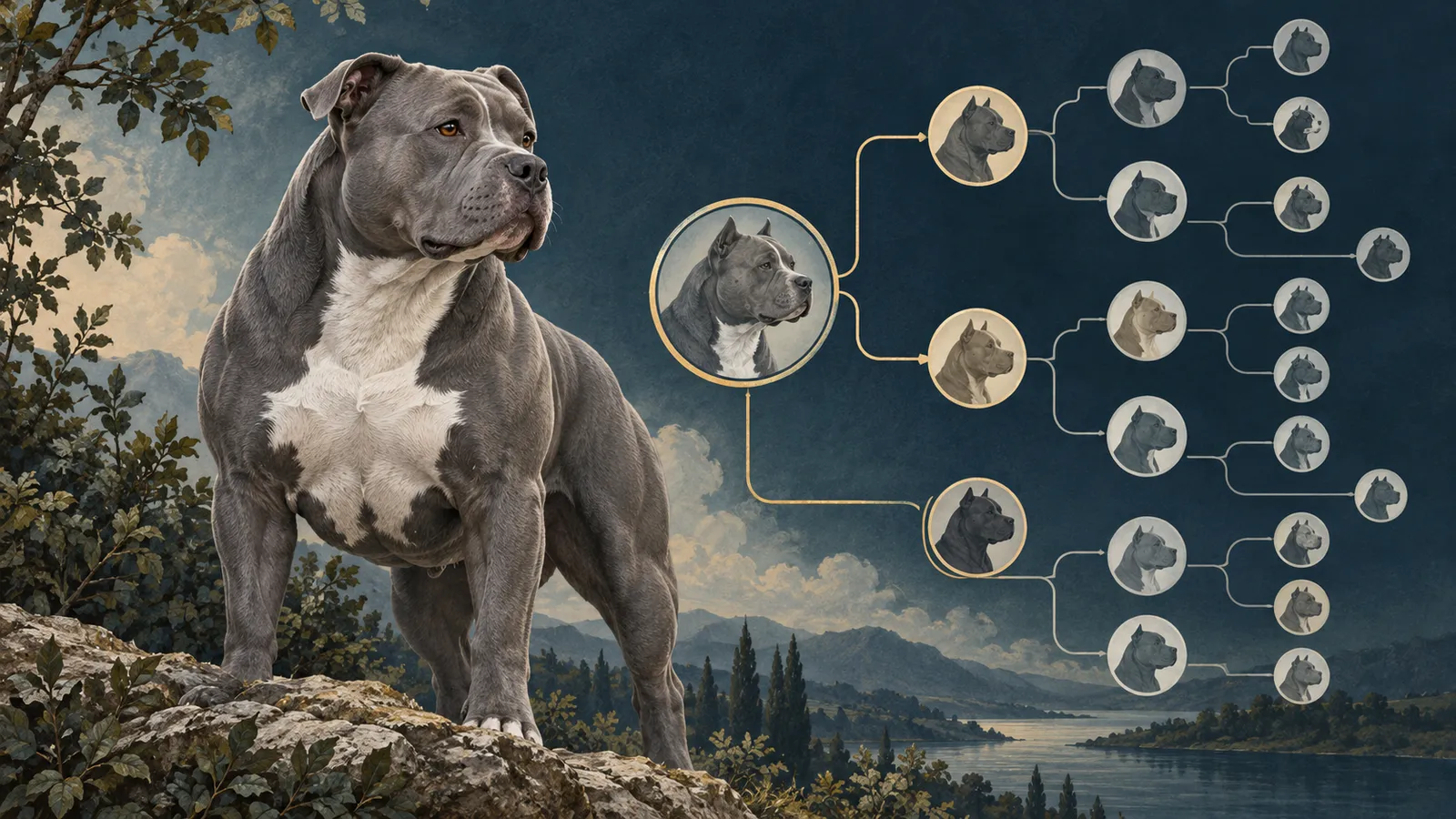
Reading a COI Report Before You Plan a Litter
Understanding the number, the pedigree behind it, and the questions it should help you ask.
A proposed breeding can look impressive on paper. Both dogs may have accomplished ancestors, recognizable kennel names, and characteristics you want to preserve. A coefficient of inbreeding report adds another perspective: how closely the two sides of that pedigree connect.
Usually shortened to COI, the pedigree-based coefficient estimates the probability that a puppy inherits two copies of a gene variant that trace back to the same ancestor. It does not measure the percentage of a puppy that is “inbred,” and it does not predict a particular disease. It describes a genetic relationship. University of Missouri: understanding inbreeding
Start with the report’s method
Before comparing percentages, establish whether you are reading a pedigree COI or a genetic COI.
Pedigree COI is calculated from recorded ancestry. Its usefulness depends on accurate parentage, complete records, and the number of generations included.
Genetic COI uses DNA information to estimate how much of a dog’s genome occurs in matching stretches inherited through both parents. It can reveal shared ancestry that a short pedigree misses. The two measurements are related, but their percentages are not automatically interchangeable. Embark: pedigree and genetic COI
A report showing no shared ancestors within three generations answers a much narrower question than one examining ten generations. Missing ancestors do not prove unrelated ancestry.
What do the familiar percentages mean?
Under simplified assumptions (unrelated, non-inbred founders), these matings produce the following expected pedigree COIs:
| Relationship between parents | Expected offspring COI |
|---|---|
| First cousins | 6.25% |
| Half-siblings | 12.5% |
| Full siblings | 25% |
| Parent and offspring | 25% |
These are relationship examples, not safe-breeding thresholds. Additional shared ancestry can raise the result. The Royal Kennel Club advises considering a pairing below the relevant breed average, all other considerations being equal, while emphasizing that COI should not be the only breeding consideration. Royal Kennel Club: inbreeding guidance
For American Bullies, a universal “safe COI” should not be presented without a validated reference population and a stated calculation method. A percentage from one database may not be comparable with a percentage from another.
Look behind the total
An ancestor-contribution report helps explain where the calculated inbreeding comes from. Examine ancestors shared by the sire and dam, how close they appear, and the separate paths connecting them.
Repeated appearances alone are not the calculation. A dog appearing several times on only one side does not automatically create the same contribution as an ancestor connecting both parents. Proper calculations account for valid pedigree paths and the common ancestor’s own inbreeding. University of Missouri: pedigree calculations
Also distinguish contribution to COI from expected ancestry contribution. They answer different questions.
Use the report to improve the decision
Before committing to a pairing, record the calculation method, pedigree depth, missing ancestors, and proposed litter COI. Review these alongside documented health screening, temperament, structure, and family history.
The most useful COI report is one that leads to better questions: Are the records complete? Is the shared ancestry intentional? Could another suitable pairing preserve the qualities you value while reducing relatedness?
A percentage should help inform that conversation. It should never end it.